

Droplixer: Building the New Infrastructure for Global Electronics After-Sales Service
Date:2026.08.24 15:09Views:4165
The global electronics industry has become increasingly internationalized. Smartphones, computers, smart hardware, consumer electronics, and industrial electronic devices can now be sold across dozens or even hundreds of countries.
Yet the after-sales service infrastructure supporting these products remains highly fragmented.
For an OEM, the challenge is not simply how to repair one device.
The real challenge is how to manage millions of service requests across different countries, service providers, technicians, warranty policies, spare-parts networks, and local operating environments.
This is the problem Droplixer is attempting to solve.
Droplixer positions itself as a Global Electronic Product Service Cloud rather than simply another repair-management application.
Its goal is to connect four key participants:
OEMs → Service Partners → Technicians → Consumers
into a global operating system for electronics after-sales service.
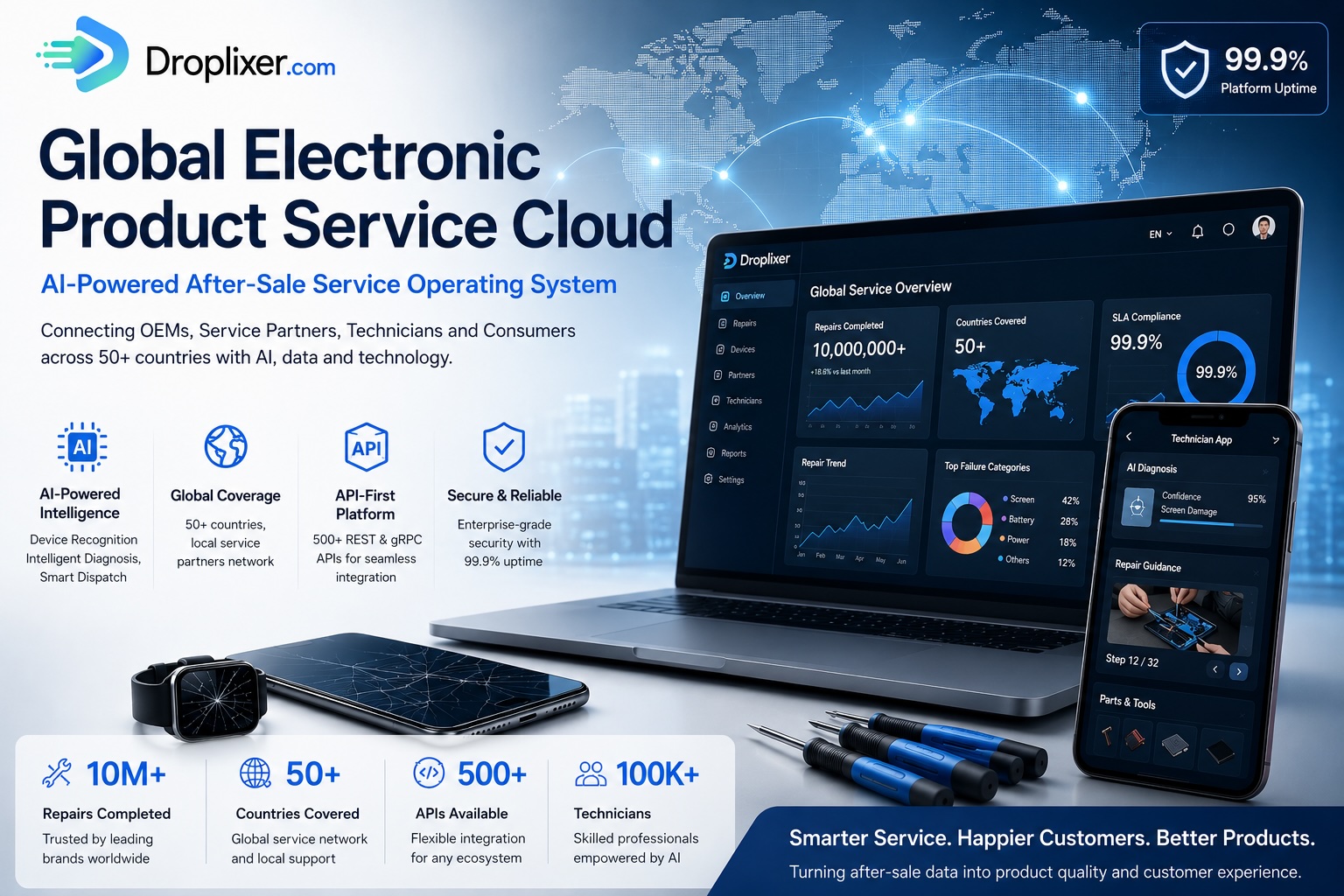
According to Droplixer, its platform currently covers more than 50 countries, has processed more than 10 million repairs, and provides more than 500 APIs, with a stated platform availability of 99.9%.
The strategic significance of this positioning is important.
Traditional after-sales systems are typically enterprise-internal applications:
· ERP manages orders and business processes.
· CRM manages customers.
· WMS manages inventory.
· Field Service Management manages field operations.
Droplixer is attempting to connect these capabilities across companies, countries, and service networks.
In the long term, this makes Droplixer less like a conventional SaaS application and more like infrastructure for global electronics after-sales service.
Based on the capabilities presented on its website, Droplixer has developed an integrated platform covering multiple participants in the service ecosystem.
For electronics manufacturers, one of the most important questions after a product is sold is:
What is actually going wrong with our products?
Droplixer’s OEM Console provides manufacturers with capabilities for global repair analytics, quality analysis, and warranty-cost forecasting.
After-sales data therefore becomes much more than a cost-center dataset.
Repair records can be transformed into:
· Product quality intelligence
· Batch defect analysis
· Failure trend analysis
· Warranty cost intelligence
· Service-provider performance data
· Product improvement insights
This creates a closed loop:
Product Sales → Product Usage → Failure → Repair → Data → Product Improvement
After-sales service is no longer simply the final stage of the product lifecycle. It becomes a source of intelligence for the entire product organization.
A major challenge of global after-sales service is that an OEM cannot realistically build and operate its own repair organization in every market.
Local service partners therefore become essential infrastructure.
Droplixer’s Partner Portal supports service-provider operations including work-order management, technician management, and settlement.
This creates the foundation for a network effect:
More OEMs join the platform.
More service providers join the network.
More technicians become available.
More repair data is generated.
AI diagnosis and service optimization become more accurate.
The platform then becomes more attractive to additional OEMs.
This is fundamentally different from a traditional single-enterprise SaaS model.
The emerging model is closer to:
SaaS + Marketplace + Network + AI
One of the most interesting aspects of Droplixer is that AI is not positioned merely as a chatbot.
Instead, AI is embedded into the entire repair workflow.
Droplixer highlights capabilities including:
· AI Device Recognition
· Intelligent Diagnosis
· Smart Dispatch
· Quality Intelligence
A consumer or technician can scan an electronic device.
The system can identify information such as:
· Product model
· Serial number
· Warranty status
Droplixer states that its recognition accuracy exceeds 95%.
This solves the first fundamental problem in after-sales service:
“What exactly is this device?”
The second question is:
“Why did it fail?”
Droplixer applies multimodal AI to electronics diagnosis, using information such as:
· Product images
· Voice descriptions
· User-reported symptoms
· Device information
The system can then generate potential repair solutions and cost estimates.
This changes the first stage of the repair process.
Instead of immediately sending every problem to a professional technician, consumers may increasingly be able to:
Take a picture + describe the problem → Receive an AI-powered initial diagnosis
This has the potential to significantly reduce unnecessary service requests and improve first-time resolution rates.
Another persistent problem in repair operations is not necessarily a lack of technicians.
It is knowing:
Who is the right technician for this particular job?
Droplixer’s Smart Dispatch matches service requests with technicians based on factors such as:
· Skills
· Geographic location
· Current workload
· Predicted success rate
This represents an evolution from traditional work-order dispatching toward an:
AI Technician Matching Engine
With sufficient historical data, the system could potentially predict:
· Probability of successful repair
· Expected repair duration
· Expected repair cost
· Probability of repeat repair
· Customer satisfaction
Dispatching could therefore evolve beyond “nearest technician first” into a sophisticated optimization problem.
The greatest value of repair data may not be helping technicians repair individual devices.
It may be helping OEMs understand:
Why are these products failing in the first place?
Droplixer highlights capabilities such as:
· Failure Trend Analysis
· Batch Defect Detection
· Predictive Warranty Cost Modeling
This enables after-sales data to flow back into product development and supply-chain management.
For example:
A particular product model may show an unusually high battery failure rate in Southeast Asia.
A specific production batch may exhibit a significantly higher return rate than historical averages.
A particular component supplier may be associated with increasing repair rates.
These insights can then feed into:
R&D → Procurement → Manufacturing → Quality → Sales → After-Sales
creating a closed product lifecycle management loop.
Another strategically important element of Droplixer is its API-first architecture.
The company states that its platform provides more than 500 REST and gRPC APIs for OEM integrations, partner connectivity, and ecosystem development.
This means enterprises do not necessarily need to replace their existing systems.
A large electronics company may already have:
· SAP
· Salesforce
· Oracle
· Proprietary CRM systems
· Warranty management systems
· Supply-chain platforms
Droplixer can serve as an integration layer connecting these systems with a global service network.
This makes Droplixer closer to:
Electronic Product After-Sales Service Infrastructure
rather than a standalone SaaS application.
The future repair technician may no longer rely primarily on personal experience.
Droplixer’s Technician App incorporates capabilities such as AI-guided repair workflows, AR instructions, and performance tracking.
Imagine a future repair scenario:
A technician picks up a device.
The system automatically identifies the model.
AI determines the most likely failure.
The system displays the appropriate disassembly procedure.
AR guides the technician through the repair.
AI continuously updates its diagnosis based on the repair process.
The system automatically records the parts used.
A service report is generated automatically after completion.
The technician therefore evolves from:
An experience-dependent manual worker
into:
An AI-augmented field-service professional.
From a business-model perspective, Droplixer’s value extends far beyond reducing repair costs.
The platform potentially connects four major categories of data.
Models, serial numbers, product lifecycle information.
Failure types, frequency, symptoms, and potential causes.
Technicians, repair duration, repair cost, and success rates.
Service requests, warranty claims, satisfaction, and service experience.
Once these datasets are unified, Droplixer could potentially expand into:
Warranty Intelligence
Product Quality Intelligence
Service Intelligence
Predictive Maintenance
and eventually:
AI-Powered Product Lifecycle Management
This may ultimately represent the platform’s greatest strategic value.
The traditional electronics value chain looks like:
R&D → Procurement → Manufacturing → Sales → Consumer
Droplixer is addressing the final segment that has historically received less technological attention:
Product → Usage → Failure → Service → Data → Product Improvement
The result is a more complete:
Product Lifecycle + Service Lifecycle
ecosystem.
Droplixer’s long-term opportunity is therefore not simply to build a better repair-management platform.
It is to build a global:
An OEM could potentially connect to global after-sales service capabilities through APIs.
Consumers could receive more standardized, transparent, and intelligent repair services.
Technicians could receive AI-assisted workflows.
Service providers could gain digital infrastructure for orders, dispatching, and settlement.
OEMs could gain global service data and product-quality intelligence.
This represents a powerful combination of:
AI + SaaS + API + Service Network
As the number and complexity of electronic products continue to grow, and as multimodal AI, computer vision, AR, and intelligent agents mature, electronics after-sales service itself is moving from a labor-intensive function toward an intelligent infrastructure industry.
That is the transformation Droplixer is attempting to enable.
The ultimate evolution is not simply:
“Repair a device.”
It is:
“Manage the service lifecycle of electronic products at global scale.”
And that may be the most important aspect of Droplixer to watch.
Recommend
Contact Us
COPYRIGHT©2026 Huahui Times International Limited.


